ALBERT EINSTEIN, BORIS PODOLSKY, NATHAN ROSEN (KIEFER, CLAUS) (Sin clasificar)



 In the spring of 1919, two British solar eclipse expeditions confirmed the correctness of general relativity theory and propelled Albert Einstein to instant celebrity. Before this major turning point, the majority of Einstein's writings published in this volume dealt with the clarification of general relativistic problems, such as the status of the metric field, the character of gravitational waves, the problem of energy-momentum conservation, and questions of cosmology, such as the nature and size of the universe and the distribution of matter within it. After his rise to international fame, Einstein's publications changed markedly. He faced an increasing demand for popular articles and lectures on relativity, its development and meaning. He also felt compelled to respond to a host of commentators, ranging from skeptical physicists to philosophers trying to reconcile his revolutionary theory with their views. For the first time, he also responded in print to outspoken anti-relativists, some of them fueled by cultural conservatism and, frequently, anti-Semitism. Einstein used his newly won fame to lend prestige to political causes, especially to the reconciliation among European nations and to Zionism. In the early years of Weimar Germany, Einstein spoke out vigorously for the young republic, emphasizing the rights of the individual. He agonized over the misery of the Central Europeans in the grip of starvation and economic collapse, praised the support of individuals and groups such as the Quakers, and championed the cause of Eastern European Jews. His rejection of assimilation, combined with a fierce defense of the right of Jews to higher education, led Einstein to campaign for the establishment of a university in Palestine, the land which he conceived of as a cultural center for all Jews. Since this supplementary paperback includes only select portions of Volume 7, it is not recommended for purchase without the main volume.
 Mileva Maric (Titel, Serbia, 1875-Zúrich, Suiza, 1948) fue la primera esposa de Albert Einstein. Cuando el que sería autor de la teoría de la relatividad temrinó sus estudios, sólo Mileva creyó en él y estuvo a su lado, ayudándole con sus conocimientos matemáticos (superiores a los de él) y físicos, y también con su apoyo, ya que le infundió espíritu de trabajo, constancia y rigor.





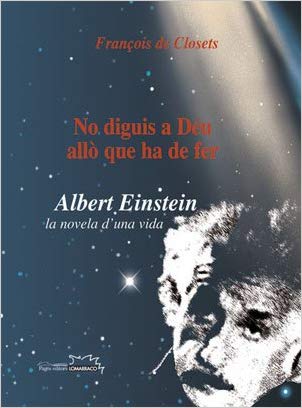 Einstein o la revenja del destí. Durant els seus primers quaranta anys de vida, el pare de la relativitat construeix la seva personalitat contra tot i contra tothom fins que esdevé el físic més gran del seu temps. Als quaranta anys, la seva vida pren un tombant oposat a tot allò que havia triat. Lós solitari és devorat per la seva pròpia fama i arrossegat pel tumult del món. Tot i que ha oblidat els seus orígens jueus, es veu obligat a unir-se al sionisme; tot i ser pacifista i defensor de l'objecció de consciència, acaba incitant el president Roosevelt a construir la bomba atòmica. Pel que fa al savi genial, aquest s'entossudeix en els seus convenciments i rebutja la nova física. "Déu no juga als daus", repeteix incansable fins que Niels Bohr li replica: "Qui és vostè, Einstein, per dir-li a Déu el que ha de fer?"Aquesta novel·la d'una vida és també la novel·la d'un segle portador de totes les barbàries. Un món en ebullició, uns personatges novel·lescos, unes escenes engoixants...Sota la ploma de Françoise de Closets, el relat biogràfic pren la força i els colors duna epopeia. I el lector es trobarà amb la sorpresa agradable dentendre una història podia semblar reservada als especialistes.