LA SUPRESIÓN DEL PUDOR Y OTROS ENSAYOS


HEGEL, FILÓSOFO DE LA HISTORIA VIVIENTE
 La filosofía de la historia es, en la forma final que le confieren las "Lecciones" de Berlín, uno de los aspectos más difamados de la obra de Hegel. Sin entrar en discusión respecto de la legitimidad de muchos de los reproches que se formulan a este gran filósofo y creyendo superado todo el hegelianismo, Jacques DHondt se vuelve hacia Hegel con mirada distinta y audaz a fin de valorar un pensamiento que interesa a nuestra época y nos afecta íntimamente, defendiendo un patrimonio y mostrando que una herencia cultural es un manantial inagotable. Devuelta a su contexto histórico, inserta en su tiempo y su universo, pero a la vez reconocida y asimilada por el pensamiento moderno, que tanto le debe, la filosofía de la historia recupera los tesoros que un drástico desarraigo le haría perder, halla nuevamente un significado seductor, recobra su dignidad de obra grande y orgullosa, inquietante y atormentada.
SPINOZA UND SCHLEIERMACHER
 This work has been selected by scholars as being culturally important and is part of the knowledge base of civilization as we know it.This work is in the public domain in the United States of America, and possibly other nations. Within the United States, you may freely copy and distribute this work, as no entity (individual or corporate) has a copyright on the body of the work.Scholars believe, and we concur, that this work is important enough to be preserved, reproduced, and made generally available to the public. To ensure a quality reading experience, this work has been proofread and republished using a format that seamlessly blends the original graphical elements with text in an easy-to-read typeface.We appreciate your support of the preservation process, and thank you for being an important part of keeping this knowledge alive and relevant.
THE POSITIVE PHILOSOPHY OF AUGUSTE COMTE
 This work has been selected by scholars as being culturally important and is part of the knowledge base of civilization as we know it.This work is in the public domain in the United States of America, and possibly other nations. Within the United States, you may freely copy and distribute this work, as no entity (individual or corporate) has a copyright on the body of the work.Scholars believe, and we concur, that this work is important enough to be preserved, reproduced, and made generally available to the public. To ensure a quality reading experience, this work has been proofread and republished using a format that seamlessly blends the original graphical elements with text in an easy-to-read typeface.We appreciate your support of the preservation process, and thank you for being an important part of keeping this knowledge alive and relevant.
NICOMACHEAN ETHICS
 This work has been selected by scholars as being culturally important and is part of the knowledge base of civilization as we know it.This work is in the public domain in the United States of America, and possibly other nations. Within the United States, you may freely copy and distribute this work, as no entity (individual or corporate) has a copyright on the body of the work.Scholars believe, and we concur, that this work is important enough to be preserved, reproduced, and made generally available to the public. To ensure a quality reading experience, this work has been proofread and republished using a format that seamlessly blends the original graphical elements with text in an easy-to-read typeface.We appreciate your support of the preservation process, and thank you for being an important part of keeping this knowledge alive and relevant.
ARRISKUAREN ERAKETA DINAMIKAK
INTELIGENCIA SENTIENTE.
LA TERCERA ROMA
CONSOLACIÓN DE LA FILOSOFÍA, LA

ESO QUE SOMOS. LA IDENTIDAD EN LA SOCIEDAD QUE VIENE
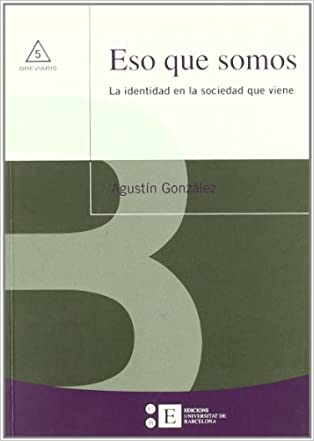 Eso que somos. La identidad en la sociedad que viene es un sistemático y preciso recorrido por los centros nucleares desde los que decimos ser lo que somos. Una invitación que el autor hace al lector para recorrer juntos los caminos que abren las preguntas por el hombre y dejar que sea él quien acabe dando las respuestas. Los problemas de la identidad en sus aspectos personal, cultural y político, los problemas que a la moral plantea el uso de las modernas tecnologías, la necesidad de responder, en un mundo en proceso de globalización, a la pregunta por la cultura, la necesidad de saber qué somos y el valor de los principios desde donde orientamos nuestras acciones.